
How RREHD ONE changed departures over West County
RREHD ONE concentrated departures over West County. Residents spent more than two years seeking relief before quieter skies during Bohemian Grove sharpened their frustration. What changed, and where do efforts to secure lasting relief stand?
By Malcolm Crawford
In January 2024, the Federal Aviation Administration (FAA) introduced RREHD ONE (pronounced “Redhead One”), a new departure procedure for flights leaving Charles M. Schulz–Sonoma County Airport. The earlier procedure had allowed controllers to spread departures over a wider area; RREHD ONE concentrated them along a narrower corridor over West County. Some residents reported a sharp increase in noise and soon began seeking relief. More than two years later, a change in departure assignments during Bohemian Grove brought residents some of the quiet they had been asking for — and sharpened their frustration that their own requests had not produced the same result.
RREHD concentrated departures along a more predictable route
Sonoma County Airport lies north of Santa Rosa, with West County communities such as Occidental to its southwest. A southbound flight needs a way to climb safely and join the traffic moving through the Bay Area. A departure procedure supplies the instructions for that first part of the journey.
Before RREHD, the FAA relied on a procedure known as CHARLIE. Air traffic controllers told pilots which directions to fly, within prescribed safety limits, allowing departures to spread over a wide area.[1]
The retirement of Santa Rosa's ground-based navigation beacon in 2021 left CHARLIE as the airport's only instrument departure procedure, the FAA said. In January 2024, it introduced RREHD ONE, along with two other new departures. These used modern navigation systems to guide aircraft through a sequence of designated points. The FAA said the new procedures would keep Sonoma County departures separated from the busy arrival and departure flows serving San Francisco and Oakland. More predictable flight paths, it said, would improve safety and efficiency while reducing controllers' workload.[2]
RREHD sends aircraft west or southwest of the airport before they continue south. These flights converge at a point also called RREHD, then follow a common route toward the Bay Area.[3] That repeatability was part of its purpose. It was also central to the noise problems some residents experienced.
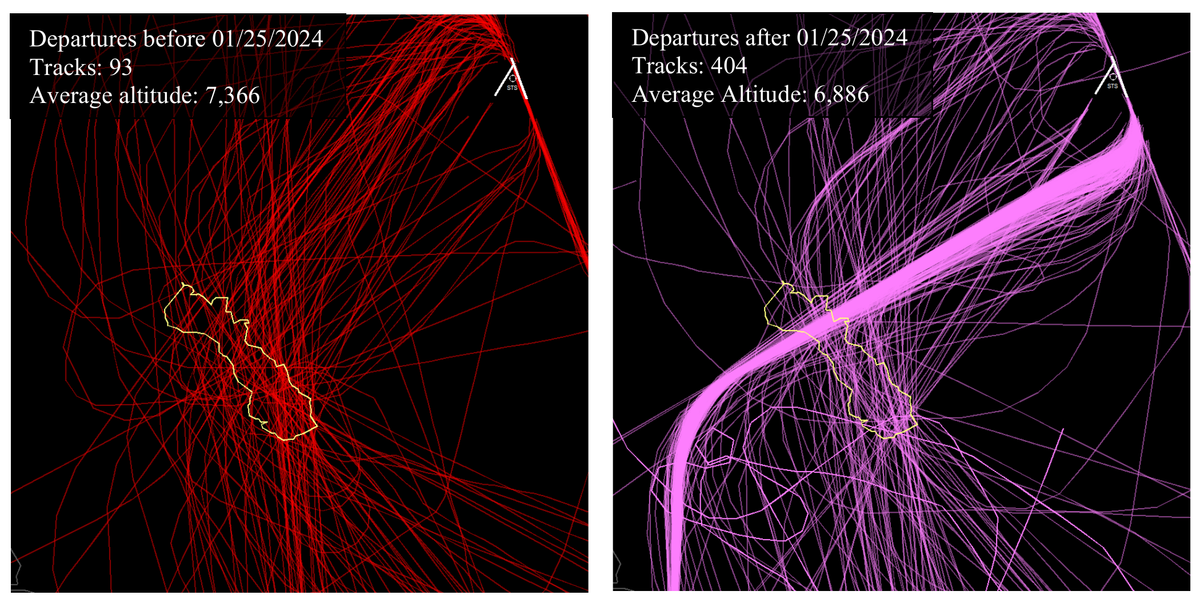
The FAA’s departure tracks over the Occidental area before (left) and after (right) RREHD began, with 60 sampled days in each panel. The airport (STS) is at upper right; the yellow outline marks the Occidental comparison area to its southwest. Source: FAA, May 12, 2025 [2:1].
Residents sought relief from repeated flights over their homes
Spreading flights over a wide area can mean fewer pass over any one home. Concentrating departures along a similar path can leave the same households hearing one aircraft after another. The FAA's review found lower average departure altitudes over Occidental after RREHD began.[2:2] Residents described noise they found intolerable, disrupting their sleep and enjoyment of time outdoors.[1:1] [4]
Residents organized, filed complaints, and pressed local and federal officials to intervene. One recurring request was to return to CHARLIE while a better alternative was developed. County officials enlisted Representative Jared Huffman to press the FAA for changes.[4:1]
In May 2025, responding to a request from Supervisor Lynda Hopkins, the FAA said it could not return to using CHARLIE alone. It said Bay Area flight procedures were interconnected and that changes required study of their effects on other traffic and communities “to avoid merely shifting the noise.”[2:3] As airport manager Jon Stout later explained, CHARLIE remained available as an alternative.[4:2]
Quieter skies during Bohemian Grove sharpened residents’ frustration
In July 2026, the Bohemian Grove summer gathering near Monte Rio brought extra private-jet traffic to the airport, and controllers made more use of CHARLIE. Residents reported quieter skies, and Stout reported fewer aircraft using RREHD and fewer complaints. The airport tower's explanation was traffic management: the FAA's regional control center had turned to CHARLIE to handle the extra flights.[4:3][5]
Residents who had spent more than two years seeking relief questioned why their requests had achieved so little, while the gathering had brought quieter skies. Hopkins, whose district includes West County, told The Press Democrat that such a change seemed possible “for the rich and powerful elite, not for citizens of the county.” The Bohemian Club said it had not lobbied for the change.[4:4]
RREHD remains in place while the County pursues changes
RREHD ONE remains in place. In August, the FAA said that normal departure arrangements had resumed after the extra event traffic cleared. CHARLIE remained available, and in November County staff said it appeared to be used regularly. Those reports do not show how much of July's relief lasted.[3:1][6]
The County says RREHD II, a proposed revision developed by its aviation consultant Cignus, has been submitted to the FAA. It aims to reduce noise along the existing West County route by adjusting turns and requiring higher altitudes at certain points. The airport is also asking the FAA to reconsider which flights use RREHD and which can use CHARLIE.[6:1]
On November 3, the Board of Supervisors approved further consulting work to explore new arrival and departure routes. That includes considering departures that give controllers room to vary paths, as CHARLIE does. The Board's approval funds development of alternatives; RREHD II and any new routes still need FAA review and approval before they can be put into use.[6:2]
Sources and notes
Status as of November 16, 2026. Page references are PDF file pages.
Earlier departures and residents’ experience. Cignus Consulting, Approach Development Feasibility Study, final report, May 2025, p. 8 for CHARLIE’s controller-directed departures, and pp. 19–21 for residents’ concerns about noise, sleep, outdoor activities, and changed flight paths. ↩︎ ↩︎
The FAA’s explanation and track comparison. Raquel Girvin, FAA Regional Administrator, letter to Sonoma County Board Chair Lynda Hopkins, May 12, 2025, pp. 1–4. Released by Sonoma County under California Public Records Act request 26-373; copy retained in the author’s research files. Page 1 explains the beacon’s retirement, RREHD’s introduction, and the FAA’s regional-traffic rationale. Page 4 gives its response to the request to return to CHARLIE alone. The illustration reproduces the two departure panels on p. 2, retaining their original labels. The FAA describes 60 sampled days before and 60 after implementation, using community areas defined from census data; it does not supply the exact dates or underlying track data. Altitudes are in feet above mean sea level. The comparison shows increased departures over the defined Occidental area and fewer over the defined Sebastopol area; it does not measure sound or establish every household’s experience. ↩︎ ↩︎ ↩︎ ↩︎
The published route. FAA, RREHD ONE Departure (RNAV), cycle 2611, effective October 29–November 26, 2026. The chart supplies the runway-dependent departure instructions and the route through RREHD. A published procedure is distinct from its assignment to a particular flight, and the chart is explicitly not to scale. ↩︎ ↩︎
Residents’ reaction, requests for relief, and the Club’s response. Phil Barber and Anna Armstrong, report on Bohemian Grove and changed departures, The Press Democrat, July 24, 2026, updated July 31. The report includes residents’ accounts, Supervisor Lynda Hopkins’s reaction, Jon Stout’s explanation that CHARLIE remained available, and the Bohemian Club’s denial that it lobbied for the change. Access may require a subscription. ↩︎ ↩︎ ↩︎ ↩︎ ↩︎
The July traffic-management explanation. Cole Dietrich to Jon Stout, “RE: Procedure Change,” July 15, 2026, 10:23 a.m.; Jon Stout to Johannes Hoevertsz, “FW: STS takeoff diversions,” July 15, 2026, 4:18 p.m. Email chains released by Sonoma County under California Public Records Act request 26-373; copies retained in the author’s research files. Dietrich attributes increased CHARLIE use to Oakland Center’s handling of additional instrument-flight traffic during Bohemian Grove. Stout reports fewer RREHD flights and fewer complaints, without a count. These records establish the contemporaneous explanation, not the underlying operational directive or the feasibility of a permanent arrangement. ↩︎
What happened after July and the proposals now under review. KQED’s August 5, 2026 report gives the FAA’s account that normal arrangements resumed after the extra event traffic cleared. The County’s November 3 staff report, pp. 2–3, says CHARLIE appears still to be used regularly; pp. 5–6 describe the RREHD II submission and requests concerning departure assignments; pp. 8–10 describe broader route-development work. The November 3 Board meeting recording, approximately 02:59:39–03:00:33, records approval of the consulting work. Funding that work does not approve or implement a route, and these sources do not quantify how much of July’s reported relief lasted. ↩︎ ↩︎ ↩︎
Researched and drafted in collaboration with Claude (Anthropic) and ChatGPT (OpenAI).