
Could more flights make Sonoma County less inviting?
Sonoma County wants to make it easier to fly to wine country. If the flights spoil the peace visitors come for, that’s like inviting friends over for dinner and then shitting in the lasagna.
By Malcolm Crawford
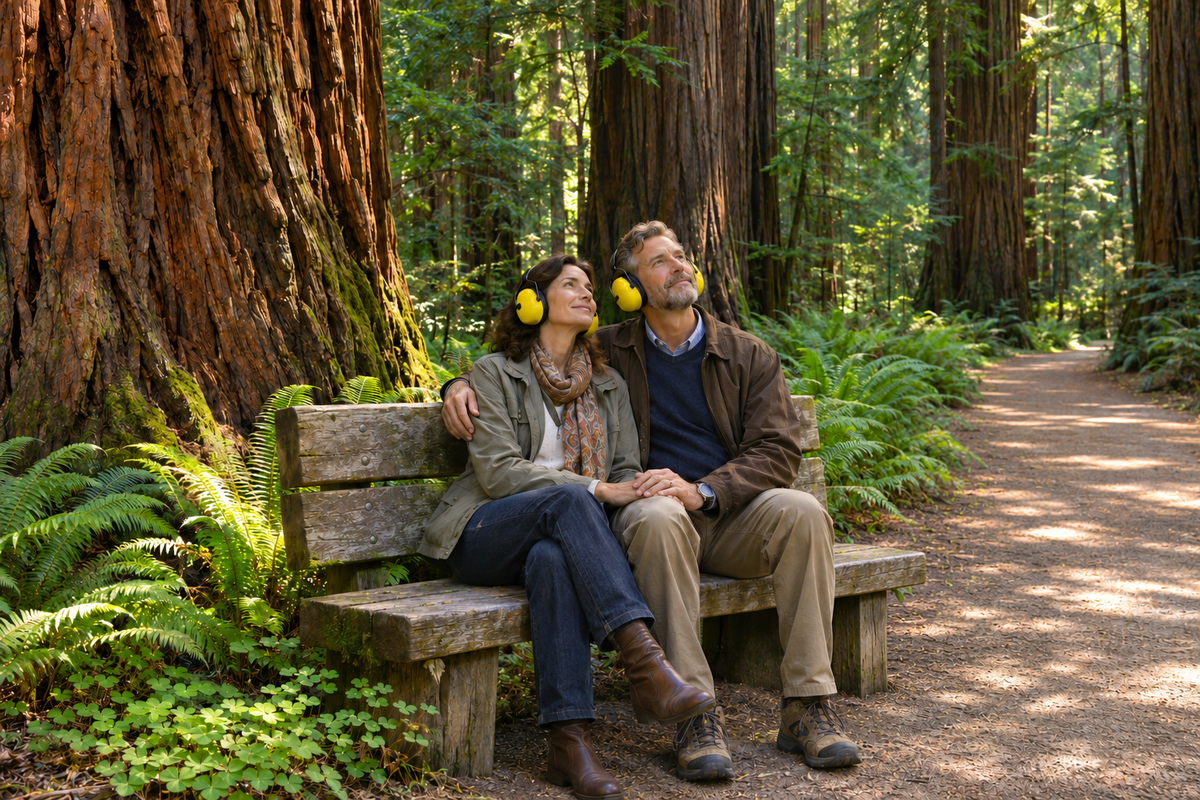
A direct flight can give a visitor an extra afternoon in wine country. But a flight over a quiet garden can take something away from the afternoon of a visitor who drove there. Before Sonoma County promotes more flights as good for tourism, it should weigh the value of easier access against the risk of spoiling what visitors came to enjoy.[1]
When Southwest added a seasonal Saturday nonstop from Austin to Santa Rosa, Sonoma County Tourism promoted the easier access it would give Texans to the coast, wine country, and redwood forests. In its guide to Armstrong Redwoods, the same organization invites visitors to experience the grove’s “sacred silence.”[2] It also recommends a West County back-roads outing through Graton, the meadows at Hallberg Butterfly Gardens, and the trail between Forestville and Sebastopol.[3] Sonoma County Tourism is selling access and quiet in the same breath.
The County heard the case for quiet in 2011 and again in 2024
In September 2011, two speakers put that tension before the Sonoma County Planning Commission. Mark Crabb, the local tourism bureau’s director of sales, said small businesses depended on visitors and airport expansion would bring more of them. He called them “temporary taxpayers.” The next speaker, Steve Birdlebough of the Sierra Club, explained what he thought more jets would put at risk. Visitors came to Sonoma County because “they are looking for quiet, they are looking for country, they are looking for open space.”[4]
In January 2024, a new departure procedure, RREHD ONE, took effect at the airport, concentrating departures along a narrower corridor over West County. On the days it sampled, the FAA counted 93 departure tracks crossing the Occidental area before the change and 404 afterward.[5] In October that year, Sonoma County Airport asked for comments on proposed arrival routes. Two places near Occidental echoed Birdlebough’s concern.
At Western Hills Garden near Occidental, Hadley Dynak wrote:
We have noticed a significant increase in air traffic noise over Western Hills Garden, our three acre botanical preserve off Coleman Valley Road. Our property is a sanctuary where people come for retreat, respite, and healing in addition to enjoy the peacefulness of our biodiverse environment. We are hoping for mitigation of the recent noise increase and no additional airplane routes overhead.[6]
At the nearby CYO Camp and Retreat Center, Emily Ordway was looking ahead to what a proposed route might mean for guests who stayed two to seven days to get away from city noise and stress. Ordway, a camp employee, feared regular overflights would cost the camp clients.[7] For a place that offers people a few days away from noise, the quiet is part of what a guest books.
Few overnight trips to Sonoma County begin with a flight into Santa Rosa
Sonoma County received about 4.8 million overnight visits in 2025. Scheduled flights brought fewer than 400,000 passengers into Santa Rosa, including residents coming home. Even counting every arrival as an overnight visitor puts the airport’s share below one in ten.[8] However they arrived, visitors share the same gardens, trails, and winery patios.
Why people say they came is a different question from how they spend their days. Visiting friends or relatives was the main reason for 44 percent of domestic overnight trips to Sonoma County in 2024, and the outdoors was the main draw on just 7 percent. Yet 61 percent of trips included an outdoor activity.[9] A visitor who came to see family can still spend the best afternoon of the trip on a trail, so the main-purpose figure alone says little about how much the setting matters.
It is too early to tell whether lost quiet will cost the County visitors
Countywide visitation and spending rose in 2024, the year the departure route changed. Sonoma County Tourism’s provisional estimates put travel spending at $2.44 billion and travel-generated employment at about 22,500 jobs. Spending rose again in 2025.[10] Countywide spending can rise even as a particular inn loses a booking.
Returning visitors made three quarters of Sonoma County’s overnight trips in 2025.[11] They can compare this visit with earlier ones. It may be a year or two before they choose where to spend their next holiday. The airport counts a couple the moment they land, but not the family that drives back next summer because it remembers a quiet afternoon in a garden, or the one that stops coming. Spending totals record a guest’s bill whether or not the guest found the garden less peaceful, and a survey of that season’s visitors reaches the people who came, not the ones who went elsewhere.
The innkeeper may be the first to hear of a change. Suppose a guest mentions at checkout that the garden seemed less peaceful this time. The bill is paid, the guest is still there, and there is time to ask what happened.
The County answered the 2011 comments with procedure, and the question is still open
In 2011, the County’s final environmental report gave much the same answer to both men’s tourism arguments. It said neither comment directly addressed the analyses in the draft report and that both would go to the planning commissioners and county supervisors for consideration.[12]
Asking is not complicated. Flight tracks show which aircraft passed near the garden and the camp, how often, and at what times of day. Guests can say whether they heard a plane, whether it interrupted anything, and how they felt about the visit. With their permission, researchers can follow up the next season, including with people who spent their holiday somewhere else.
Fifteen years after that hearing, and after a garden and a camp put a similar concern in writing, has the County asked guests at places like Western Hills Garden whether aircraft noise affects their visit?
Sources and notes
Kelly Lord Kim raised a similar concern in the West Sonoma County Jet Noise Coalition’s May 11, 2026, letter to Rep. Jared Huffman, signed by Andrea Oreck for the coalition (pp. 2–3). ↩︎
Sonoma County Tourism, What’s New in Sonoma County – Late Summer/Early Fall 2026, “STS – AUS,” and Soulful Travel: Armstrong Redwoods State Natural Reserve. ↩︎
Sonoma County Tourism, Cruising the Back Roads of West Sonoma County, and its presentation on tourism, p. 27. For the role of background sound in how an overflight is experienced, see The same aircraft, a different impact. ↩︎
County of Sonoma, 2011 airport environmental impact report and responses to comments. In the final report, Section 5 C4, see the September 1 Planning Commission testimony of Mark Crabb and Steve Birdlebough on printed pp. 5-333–5-335 (PDF pp. 10–12) and the County’s November responses C96-3 and C96-4 on pp. 5-394–5-395 (PDF pp. 71–72). ↩︎
Sonoma Air Record, How RREHD ONE changed departures over West County, drawing on the FAA’s May 12, 2025, letter to Supervisor Lynda Hopkins, pp. 1–2. The FAA gave January 25, 2024, as the RREHD implementation date and compared the same 60 random days before and after in an Occidental area it defined from census data. It counted 93 departure tracks before the change and 404 afterward. Average departure altitude also fell, from 7,366 to 6,886 feet above mean sea level. It did not supply the exact dates or the underlying track data. ↩︎
Sonoma County Airport approach-study comments, “Occidental + CYO,” row 92 (Hadley Dynak, October 15, 2024). Workbook attached to Rachael Casarez’s June 2, 2025, email to Jon Stout, “FW: KSTS - Approach Comments.” The airport subsequently published the garden comment and response. ↩︎
Sonoma County Airport approach-study comments, “Occidental + CYO,” rows 92 (Hadley Dynak, October 15, 2024) and 164 (Emily Ordway, October 9, 2024). Workbook attached to Rachael Casarez’s June 2, 2025, email to Jon Stout, “FW: KSTS - Approach Comments.” The airport subsequently published the garden comment and response and the camp comment and response. ↩︎
Sonoma Air Record, What is more airline service actually worth to Sonoma County?, section on overnight visitors and Santa Rosa arrivals. ↩︎
Sonoma County Tourism presentation, pp. 8 and 10 (2024 visitation and provisional Dean Runyan travel spending and employment estimates), 13 (main purpose of domestic overnight trips), and 18 (activities on those trips, Longwoods International). For the subsequent year’s spending growth, see Sonoma County Tourism’s 2025 visitor statistics. ↩︎
Sonoma County Tourism presentation, pp. 8 and 10 (2024 visitation and provisional Dean Runyan travel spending and employment estimates), 13 (main purpose of domestic overnight trips), and 18 (activities on those trips, Longwoods International). For the subsequent year’s spending growth, see Sonoma County Tourism’s 2025 visitor statistics. ↩︎
Sonoma County Tourism, 2025 Visitor Profile Highlights, p. 2, Longwoods International. The survey counts overnight trips by individuals. Its repeat-visitor figure is the share of those trips made by people who had visited before. ↩︎
County of Sonoma, 2011 airport environmental impact report and responses to comments. In the final report, Section 5 C4, see the September 1 Planning Commission testimony of Mark Crabb and Steve Birdlebough on printed pp. 5-333–5-335 (PDF pp. 10–12) and the County’s November responses C96-3 and C96-4 on pp. 5-394–5-395 (PDF pp. 71–72). ↩︎